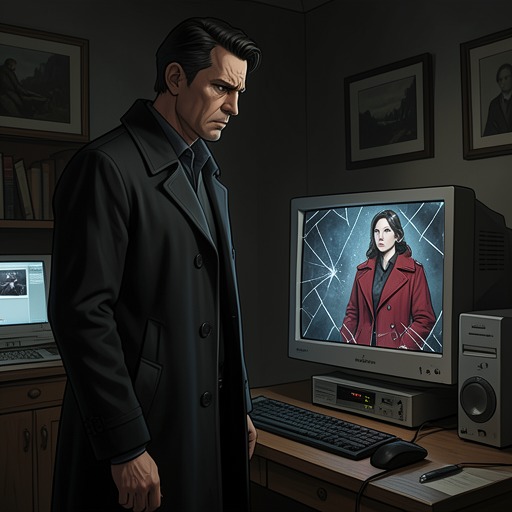
Kain
Tinea and Leah: [Cyberpunk, Alien Incursions, Murder and Mayhem, Girl's Love (WLW)]Kain is the Second of Hengst Rheinschiffer and one of the trained operatives of Söldnerklan Feuerschwarz. His significance lies less in independent authority than in the way he embodies obedience under coercion: he performs military discipline while suppressing rage, fear, and the bodily knowledge that Hengst treats him as prey. Through Kain, the clan's secrecy, conditioning, and predatory hierarchy become visible from inside.
Position Within the Clan
Kain's formal role is subordinate to Hengst Rheinschiffer. When Hengst summons him, Kain enters carrying two paper folders and reports that preparations for the next Soldatenweihe are proceeding. The clan has identified multiple suitable Weihopfer among visitors to Megacity Nuremberg and is preparing their retrieval. Kain delivers this information in the clipped, repeated register of a soldier addressing a superior, even though the subject is the planned abduction of human victims.
The distinction between Kain's title and his actual freedom is central to his characterization. Hengst calls him his Second, but Kain's movements are governed by anticipation of Hengst's reactions. When Hengst chooses a passage through the underground caverns, Kain must turn and follow, abandoning the route he wanted to take toward the older trainees. The command structure is therefore not merely administrative: it reaches into Kain's body, posture, and instinct.
Fear, Conditioning, and Self-Control
Kain's fear is presented as an active discipline rather than a momentary weakness. As he leaves Hengst's office, Hengst's breath across his nape makes his skin crawl and conjures the stink of carnivores. Kain nevertheless keeps his shoulders relaxed, drawing on experience to conceal prey behavior. His own mind recognizes the humiliation of that response, while another part of him interprets the posture as evidence of helplessness and converts it into rage.
This split between outward composure and inward revolt explains why Kain is valuable to the clan. He can preserve the appearance of a reliable operative while forcing his anger beneath a surface of stressed equanimity. Hengst reads that controlled expression as the mark of one of his best operatives, but the same control also reveals the violence required to produce obedience. Kain is not shown as peacefully loyal; he is shown surviving a system that has trained him to make fear look like professionalism.
The underground setting intensifies that history. The clan's circular caverns have protected its secrecy and anonymity for thirty years, preventing outsiders from finding the lost children held there and rescuing them from conditioning and training. Kain's presence among these passages places him on both sides of that description: he is an operative formed by the institution and a living trace of what the institution does to those it controls.
The Search for Aden Rheinschiffer
Kain's most consequential assignment begins when he handles the dossier containing a spy-satellite photograph. The image shows Aden Rheinschiffer standing on a condominium roof, an unusual samurai weapon in hand, firing upward at swarms of Antithesis. Aden's raised face makes him easy to identify even though one eye is hidden behind a scope.
The photograph transforms the report from routine intelligence into a personal command. Hengst recognizes Aden and crushes the folder's spine in his fist before ordering Kain to find him. Kain freezes under Hengst's gaze, then salutes and manages to answer in the required military form. Hengst demands more information—everything Kain can uncover, without omission—making Kain the instrument through which the clan attempts to locate Aden Rheinschiffer.
This assignment also places Kain at the junction of two kinds of violence. The folders concern the clan's planned retrieval of Weihopfer for the Soldatenweihe, while the photograph reveals Aden fighting Antithesis in the open. Kain therefore carries the machinery of clandestine predation and the evidence of an opposing combatant's intervention at the same time. His task is not simply to gather facts; it is to extend Hengst's reach beyond the caverns.
Relation to the Vanguard System
Kain's plot function becomes clearer against the Vanguard system that recognizes Aden Rheinschiffer as someone willing to protect those unable to protect themselves, even at great cost to his own safety. Tynea explains that Aden was chosen to become a Vanguard because his profile suggested he could be trusted with the power potential of that status, along with access to advanced technologies.
Kain does not share that stated protective mandate in the evidence surrounding his introduction. He serves a hidden clan that selects victims and preserves its power through secrecy and conditioning, and he is ordered to pursue Aden rather than protect the vulnerable. The contrast does not make Kain a simple ideological opposite. His behavior is shaped by fear, training, and hierarchy, so the narrative leaves open the difference between what he chooses and what the clan has made possible for him to do.
Narrative Role and Limits
Kain is presented primarily through an external account of his controlled actions and internal reactions, while Hengst's predatory perspective exposes the danger surrounding him. That arrangement restricts Kain's agency but gives his smallest gestures unusual weight: relaxed shoulders, a forced turn into another corridor, a frozen response, and a formal salute all become evidence of a person negotiating an oppressive order.
His last decisive action in the supplied material is obedience. After seeing Aden Rheinschiffer in the photograph, Kain accepts the order to find him and promises to obtain every piece of information. The ending does not provide a later reversal, escape, or act of defiance. Kain consequently remains suspended between operative competence and suppressed resistance, a subordinate whose survival skills help sustain the very hierarchy that has conditioned him.